
The Hidden Cost of Fake Outlets: When Your Outlets Data Looks Better Than Reality
Fake or duplicate outlets can hide credit risk, distort sales data, and trap company cash. Learn how Fieldfy helps verify outlets and protect revenue.

Chrisostom Kaweza
Oct 1, 2026 · 8 min read
Updated Oct 2, 2026
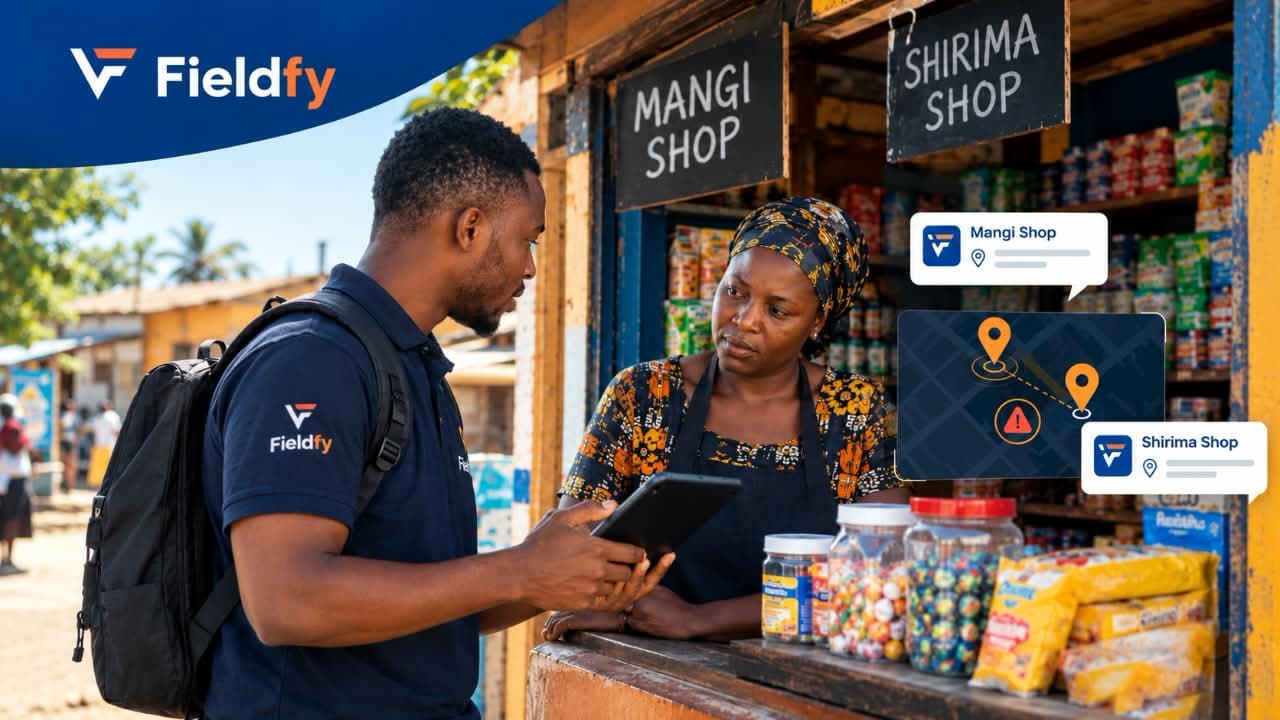
A sales representative is assigned a route in Mbagala.
His target is clear: visit outlets, generate orders, and collect payments.
During one of his visits, he discovers a shop called Mangi Shop.
The shop looks like a good opportunity. The representative supplies products worth TZS 200,000 on credit, with an agreement that the shop will pay after selling the products.
The following week, the representative returns.
“I don't have the money yet. Come next week.”
He comes back the following week.
The answer is the same.
The products have already been sold, but the shop is struggling or unwilling to settle the outstanding amount.
The representative, however, still has a sales target.
And this is where a problem can begin.
When the pressure to sell creates a data problem
Instead of continuing to record the transaction against Mangi Shop, the representative may make another arrangement.
Perhaps he supplies another order under a different agreement.
A new outlet is then recorded in the system:
Shirima Shop.
The sales number increases.
The representative gets closer to his target.
The customer receives more products.
On paper, everyone appears to have achieved something.
But there is a problem.
Mangi Shop and Shirima Shop may not actually represent two independent customers.
They may be the same physical outlet, the same owner, the same location, or simply another record created to keep sales moving.
This creates what we can call a fake, duplicate, or suspicious outlet problem.
And the consequences go far beyond one sales representative.
The problem isn't just fake outlets
When companies think about fake outlets, they may initially think:
“A rep created a customer that doesn't exist.”
But the bigger problem is what happens to the company's data and money afterward.
Imagine a distributor has 15 outlets reported by a representative.
It looks like the representative has built a strong customer network.
But after verification, management discovers that only two or three of those outlets are genuinely active, independent customers.
The remaining records may be:
Duplicate outlets
Temporary customers
Customers with incorrect information
Multiple records for the same physical shop
Outlets created to record additional sales
Customers that no longer operate
Credit customers whose outstanding balances are being moved around
Now the company's dashboard may say:
15 active outlets
while the real situation is closer to:
3 genuine outlets + 12 questionable records.
That difference matters.
Why this becomes expensive for the company
1. Money gets trapped in the market
If products are repeatedly supplied on credit to outlets that do not pay on time, the company's money is no longer under its direct control.
A company might see TZS 20 million in sales and feel that it is growing.
But if a significant portion of that money is sitting in the market as overdue receivables, the business may have a very different cash position.
Sales are not the same thing as cash.
2. Sales reports become unreliable
Management may look at outlet growth and conclude:
“Our distribution network is expanding.”
But if the outlet database contains duplicates and questionable records, that conclusion may be wrong.
You cannot make good distribution decisions from unreliable outlet data.
3. Credit risk becomes harder to see
Suppose Mangi Shop owes TZS 200,000.
If another transaction is recorded under Shirima Shop, management may not immediately realize that the same customer relationship is responsible for both transactions.
The company's exposure can therefore become larger than it appears.
4. Sales targets can unintentionally encourage the wrong behaviour
This is an important part of the problem.
The sales representative is often responding to the system around them.
If the organization measures primarily:
“How many sales did you make?”
the representative naturally focuses on making the number.
But management may actually need to measure:
“How much healthy, collectible business did you create?”
Those are not always the same thing.
So how do you detect suspicious outlets?
You don't necessarily need to accuse representatives or manually investigate every customer.
The first step is to let the system identify signals that deserve attention.
This is where technology can help.
1. Detect similar GPS locations
If two supposedly different outlets are registered at essentially the same location, that should raise a question.
For example:
Mangi Shop
Location: Mbagala : GPS A
Shirima Shop
Location: Mbagala : GPS A
That doesn't automatically mean fraud.
There could genuinely be two businesses operating in the same building or nearby.
But it is a useful signal:
“These two outlets are unusually close. Verify.”
2. Detect duplicate phone numbers
Phone numbers can be another useful signal.
If two different customers have the same phone number, the system can flag them.
For example:
Mangi Shop — 07XX XXX XXX
Shirima Shop — 07XX XXX XXX
Again, this does not automatically prove that they are the same customer.
But it gives management something to investigate.
3. Give management a “Suspicious Outlets” view
This is where the process becomes much more useful.
Instead of forcing an administrator to search through thousands of customers, the system can surface potential problems.
For example:
Suspicious Outlet Alerts
OutletPossible MatchReasonShirima ShopMangi ShopSame GPS locationABC StoreXYZ ShopSame phone numberMlimani TradersMlimani StoreSimilar name + locationNew Star ShopStar ShopSame owner/contact
The administrator can then decide what to do.
Verify.
Call the customer.
Visit the outlet.
Merge the records.
Keep them separate.
Mark as inactive.
The system does not have to make the final decision.
It simply helps management know where to look.
4. Verify the outlet, not just the sales
A powerful shift is to stop thinking of an outlet as simply a name in a database.
A real outlet should have evidence behind it.
For example:
GPS location
Phone number
Physical address
Outlet name
Contact person
Photos where appropriate
Visit history
Order history
Payment history
Assigned representative
Product activity
The more of these signals you connect, the easier it becomes to understand whether an outlet represents a genuine business relationship.
5. Connect outlet data with credit and payment behaviour
This is where the problem becomes much bigger than “fake customers.”
Imagine the system shows:
Mangi Shop
Sales: TZS 200,000
Outstanding: TZS 180,000
Last payment: TZS 20,000
Last visit: 7 days ago
Then:
Shirima Shop
Sales: TZS 200,000
Outstanding: TZS 200,000
Registered: 8 days ago
GPS: Same location as Mangi Shop
Suddenly management has a much clearer picture.
The issue isn't simply that there are two outlet records.
There may be a credit and collection problem hiding behind those records.
The goal isn't to police sales representatives
This distinction is important.
A good system should not be designed around:
“How do we catch our sales reps?”
It should be designed around:
“How do we make our sales data trustworthy?”
Sales representatives are operating under targets, customer relationships, collection challenges and market realities.
The company needs systems that create visibility without assuming bad intentions.
The objective is to make it difficult for bad data to remain invisible.
What Fieldfy can do
This is one of the areas where Fieldfy can move beyond simply recording sales visits.
Fieldfy can build an Outlet Trust Layer around the customer network.
When a new outlet is created, Fieldfy can continuously check for signals such as:
Location similarity
Is this outlet registered at or very close to another existing outlet?
Phone similarity
Is the phone number already associated with another customer?
Name similarity
Does the outlet name strongly resemble an existing customer?
Contact similarity
Does the same contact person appear across multiple outlets?
Visit patterns
Are supposedly different outlets repeatedly being visited from the same location?
Transaction patterns
Are sales, credit and payments suggesting that several customer records may actually represent one relationship?
These signals can contribute to a suspicion flag.
Not a verdict.
A flag.
From “fake outlet detection” to outlet verification
The real opportunity is bigger than simply detecting fake outlets.
It is creating a process where the company gradually builds a verified retail network.
For example:
New Outlet → Detected → Reviewed → Verified → Active
Instead of treating every newly created customer as equally trustworthy, the company can gradually build confidence around its outlet database.
Over time, management can answer better questions:
How many outlets do we actually serve?
Which outlets are genuinely active?
Which customers owe us money?
Where is our stock sitting?
Which outlets are growing?
Which outlets have stopped ordering?
Which customers need verification?
Where are duplicate records appearing?
Which routes are producing healthy business?
That is much more valuable than simply knowing how many outlets a representative entered into the system.
The bigger lesson for distributors
Your sales dashboard can tell you that sales are growing.
Your field team can tell you that they visited 15 outlets.
Your CRM can show hundreds of customers.
But the real question is:
How much of that data represents the real market?
Because when outlet data is unreliable, everything built on top of it becomes unreliable too.
Your sales reports.
Your credit exposure.
Your distribution coverage.
Your route planning.
Your customer analysis.
And ultimately, your decisions.
The solution is not to distrust your sales team.
The solution is to build enough visibility into the field that good data becomes easier to create and bad data becomes easier to identify.
Fieldfy, bringing your retailers closer.
Your team builds the network.
Fieldfy helps you understand it, activate it, and grow it.
See how distributors use Fieldfy to map retailers, track field visits, receive orders, and run promotions that drive sales.
Book a demo