
Why Knowing Your Outlet Coverage Matters More Than You Think
Most distributors can tell you last month's revenue instantly but ask how many outlets they're actually reaching, consistently, and most go quiet. Here's why outlet coverage, not just sales numbers, is the real measure of whether your distribution business is growing or just standing still

Chrisostom Kaweza
Jul 17, 2026 · 4 min read
Updated Sep 9, 2026
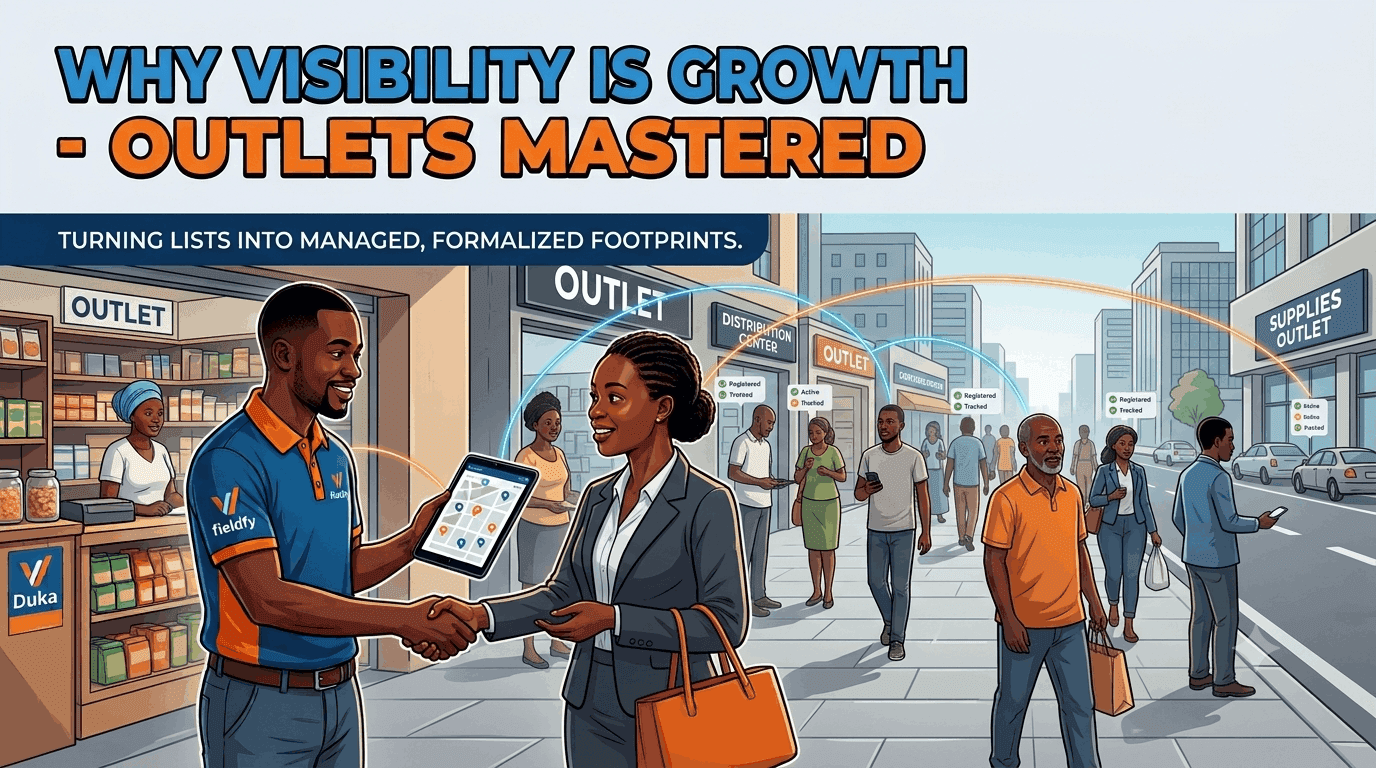
Ask a distributor how many sales reps they have, and they'll tell you instantly. Ask about last month's revenue, and they'll pull it up in seconds. Ask how many orders were delivered this week, and they'll know that too.
Now ask a different question: how many outlets are you actually reaching, consistently, right now?
Most distributors go quiet.
Coverage Is Not the Same as a Customer List
Having 500 shops in a spreadsheet doesn't mean you're serving 500 shops. An outlet that ordered once in March and never again isn't coverage it's a name on a list.
Real outlet coverage means knowing:
How many outlets are in your target territory, and how many of them are actually part of your distribution network dukas, pharmacies, sub-wholesalers, supermarkets, whatever form they take
How many are registered with you
How many have actually ordered in the last 30 days
How often each one is visited or reordering
Which outlets haven't heard from you in weeks
Which streets, wards, or districts have almost no presence at all
Without this picture, there's no way to tell whether your business is genuinely growing its footprint, or just cycling through the same handful of loyal customers month after month.
The 320 You're Not Seeing
Picture a territory with 500 outlets. Your team visits 180 of them regularly. That sounds like decent business until you realize the other 320 aren't idle. They're buying something from somewhere. If it isn't you, it's a competitor who got there first, or a sub-wholesaler quietly filling the gap you didn't know existed.
The uncomfortable truth is that most distribution businesses don't lose ground because a competitor outspends them on marketing. They lose ground one uncovered street at a time, invisibly, because nobody was tracking which outlets had gone quiet.
What Good Coverage Actually Buys You
This isn't a vanity metric. Knowing your coverage changes real decisions:
New sales opportunities appear. Every outlet you're not reaching is a market opportunity you haven't captured yet. The question is whether you find it before a competitor does.
You stop depending on a handful of big accounts. A distributor whose volume comes from five large buyers is one bad relationship away from a bad quarter. Wider coverage spreads that risk.
Route planning gets sharper. Reps stop driving past outlets that were never worth the trip and start spending time where it counts including the ones that have gone quiet and need a second look.
Product availability improves everywhere it matters. More active outlets means more shelves carrying your products, which means more places a customer can actually find what they're looking for.
You can finally answer "are we growing?" with data instead of a guess. Revenue can go up in a shrinking footprint if a few big buyers are ordering more. Coverage tells you whether you're expanding the market you touch, or just squeezing the same one harder.
This Isn't Just About Visits
It's tempting to read all of this as a field-force question are reps showing up on time, are visits logged. That's part of it, but it's the smaller part.
The real question is whether you actually understand and control your distribution footprint: your market reach, which parts of your territory you own and which you've quietly ceded, and how that footprint is changing month to month. A distributor who tracks visits but not footprint can look busy while standing still.
It Starts Smaller Than People Expect
Growth doesn't always mean a new product line or a bigger marketing budget. Sometimes it's simpler and less exciting than that: it's finding the outlets you're already supposed to be serving but currently aren't.
That's not a data problem you solve by buying more software and staring at more dashboards. It's a visibility problem you can't act on a gap you can't see.
Coverage Is a Growth Metric, Not Just a Sales Metric
Knowing your coverage isn't about collecting more information for its own sake. It's about making sharper decisions with the information you already have the ability to collect: where you're present, where you're absent, and what that gap is quietly costing you.
Assign territory based on real coverage, not assumptions. Plan routes around outlets that need attention, not just the easy ones. Spot the growth sitting in plain sight, in the streets nobody's visited in a month.
Fieldfy helps distributors understand where they're winning, where they're invisible, and where the next growth opportunity is hiding.
Know your market. Grow your distribution.
Your team builds the network.
Fieldfy helps you understand it, activate it, and grow it.
See how distributors use Fieldfy to map retailers, track field visits, receive orders, and run promotions that drive sales.
Book a demoKeep reading
Related articles
-6a61e7a0a83417.76392093.png&w=3840&q=75)
Your Delivery Truck Should Deliver Not Wait for Orders
Every minute a delivery truck waits for an order adds unnecessary cost to your distribution operation. This article explores why many distributors are separating sales from delivery, how pre-selling improves efficiency, and why connecting every order into one operational workflow is becoming a competitive advantage.
Chrisostom Kaweza
Jul 23, 2026 · 6 min read

Your Sales Team Can Be Busy and Your Distribution Can Still Be Shrinking
A busy sales team does not always mean a healthy distribution network. Learn why FMCG and pharma distributors in Tanzania lose market coverage quietly and why visibility into accounts, ordering, and field activity matters more than simply adding more sales pressure.
Chrisostom Kaweza
Jul 17, 2026 · 5 min read
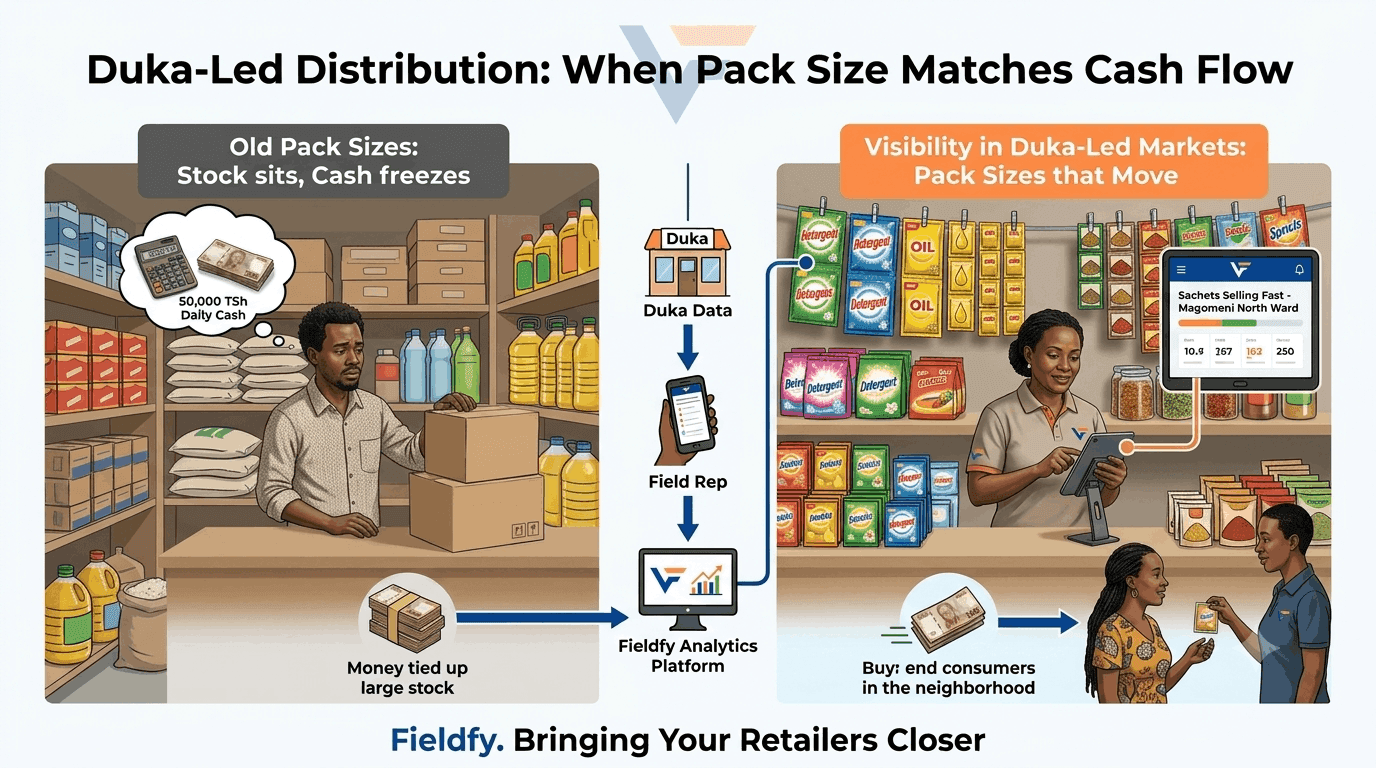
Why Your Pack Size Might Be the Reason a Duka Won't Stock You
Many manufacturers struggle to get their products into dukas not because of product quality, but because their pack sizes and pricing do not match how small retailers actually operate. Discover why pack size is a distribution strategy and how field-level visibility helps brands make smarter decisions
Chrisostom Kaweza
Jul 10, 2026 · 4 min read