
Why Your Pack Size Might Be the Reason a Duka Won't Stock You
Many manufacturers struggle to get their products into dukas not because of product quality, but because their pack sizes and pricing do not match how small retailers actually operate. Discover why pack size is a distribution strategy and how field-level visibility helps brands make smarter decisions

Chrisostom Kaweza
Jul 10, 2026 · 4 min read
Updated Aug 23, 2026
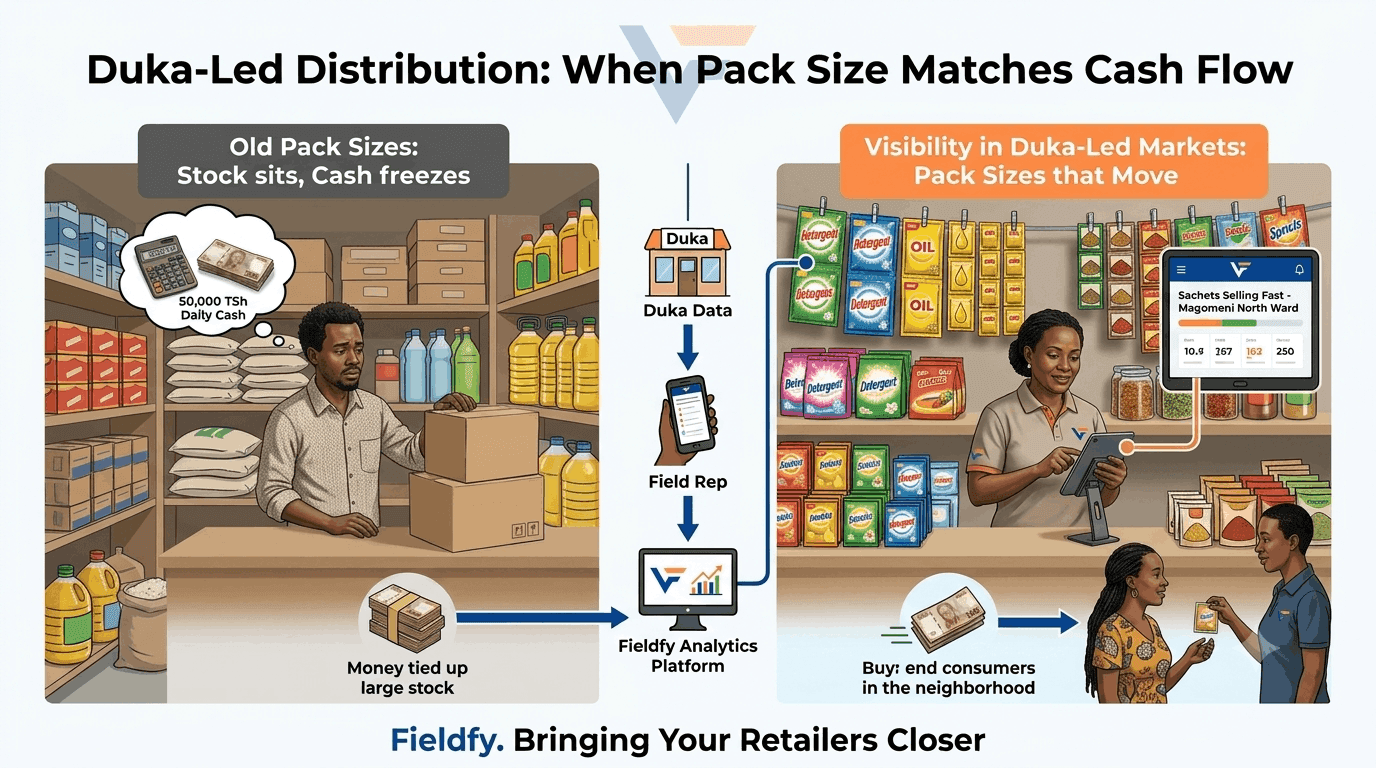
A duka owner in Magomeni doesn't have a warehouse. They don't have working capital sitting idle. Most of them are re-buying stock with the cash they made from yesterday's sales sometimes this morning's.
So when a manufacturer shows up with a product that only comes in one size, priced for a customer who buys in bulk, the duka owner does the math fast: "Will this move before I need that shelf space back?" If the answer isn't an obvious yes, the product doesn't get stocked. Not because it's a bad product. Because it doesn't fit the cash flow of the shop selling it.
This is the part of Tanzania's retail market that's easy to miss if you're planning from a spreadsheet in a head office: more than 85% of commerce here runs through small, family owned dukas, not supermarket chains. There's no central buyer making one decision for a thousand stores. There are a thousand small business owners, each making their own call, each constrained by their own cash position that day.
Pack size is not packaging. It's distribution strategy.
For manufacturers, "modular offerings" usually gets filed under marketing sachets, smaller bundles, different price points. But in a duka-led market, it's closer to a distribution decision than a design one. The size and price of what you sell determines:
Who can afford to stock it. A duka with 50,000 TSh of working capital that day can't take on a case-size order, no matter how much they'd like to.
How fast it turns over. Smaller units match daily consumer spend, which means faster resale, which means the duka reorders sooner and reorders are what keep you on the shelf.
Whether you reach the customer at all. The end consumer in most neighborhoods is also buying to match their own daily cash flow. A single use sachet isn't a lesser product it's the only version of your product some households can buy on a given day.
Get the pack size wrong for a given area, and you're not losing a sale. You're losing shelf space to a competitor whose product fits the way that duka actually operates.
Why this has to be local, not national
The mistake manufacturers make isn't ignoring modular pricing most already offer a range of sizes. The mistake is applying the same mix everywhere. A pack size that moves well in a mid-income Dar neighborhood can sit untouched in a lower-income area 5km away, or in a regional town with a completely different daily cash rhythm.
Generic market data won't tell you this. It takes field-level visibility reps actually talking to duka owners, seeing what's selling, hearing what's not moving and why to know where a smaller sachet outsells a standard pack, and where the opposite is true.
This is also where trust plays in. A duka owner who feels like a manufacturer is genuinely trying to match their cash flow not just pushing volume is a duka owner who'll give you honest feedback and stay loyal when a competitor undercuts you. Modular pricing done well is one of the clearest ways manufacturers can treat dukas as business partners instead of just another sales number.
The visibility problem
Here's the catch: most manufacturers selling through distributors don't actually see this at the duka level. They see aggregate sell-in to the distributor, not sell-through to the consumer, and definitely not which pack size is moving in which neighborhood. Without that visibility, "modular offerings" turns into guesswork launching a sachet line nationally and hoping it lands, instead of knowing in advance where it will.
This is where distributors have an advantage manufacturers can't get on their own. A distributor whose reps, orders, and retailer relationships run on their own infrastructure like Fieldfy has visibility into exactly which pack sizes are turning over fastest, in which wards, for which retailer profile. That's not a tracking exercise. It's the distributor owning a view of the market that used to live only in individual reps' heads, and being able to bring that intelligence back to the manufacturers they represent. Instead of adjusting pricing and packaging once a year based on anecdotes, the decision gets made on what's actually happening on the shelf.
The brands that win in Tanzania's duka economy aren't the ones with the biggest ad budgets. They're the ones whose product shows up in a size and price the duka owner can actually afford to sell and who have the visibility to know, area by area, what that size and price should be.
Fieldfy. Bringing your retailers closer
Your team builds the network.
Fieldfy helps you understand it, activate it, and grow it.
See how distributors use Fieldfy to map retailers, track field visits, receive orders, and run promotions that drive sales.
Book a demoKeep reading
Related articles
-6a61e7a0a83417.76392093.png&w=3840&q=75)
Your Delivery Truck Should Deliver Not Wait for Orders
Every minute a delivery truck waits for an order adds unnecessary cost to your distribution operation. This article explores why many distributors are separating sales from delivery, how pre-selling improves efficiency, and why connecting every order into one operational workflow is becoming a competitive advantage.
Chrisostom Kaweza
Jul 23, 2026 · 6 min read

Your Sales Team Can Be Busy and Your Distribution Can Still Be Shrinking
A busy sales team does not always mean a healthy distribution network. Learn why FMCG and pharma distributors in Tanzania lose market coverage quietly and why visibility into accounts, ordering, and field activity matters more than simply adding more sales pressure.
Chrisostom Kaweza
Jul 17, 2026 · 5 min read
Why Knowing Your Outlet Coverage Matters More Than You Think
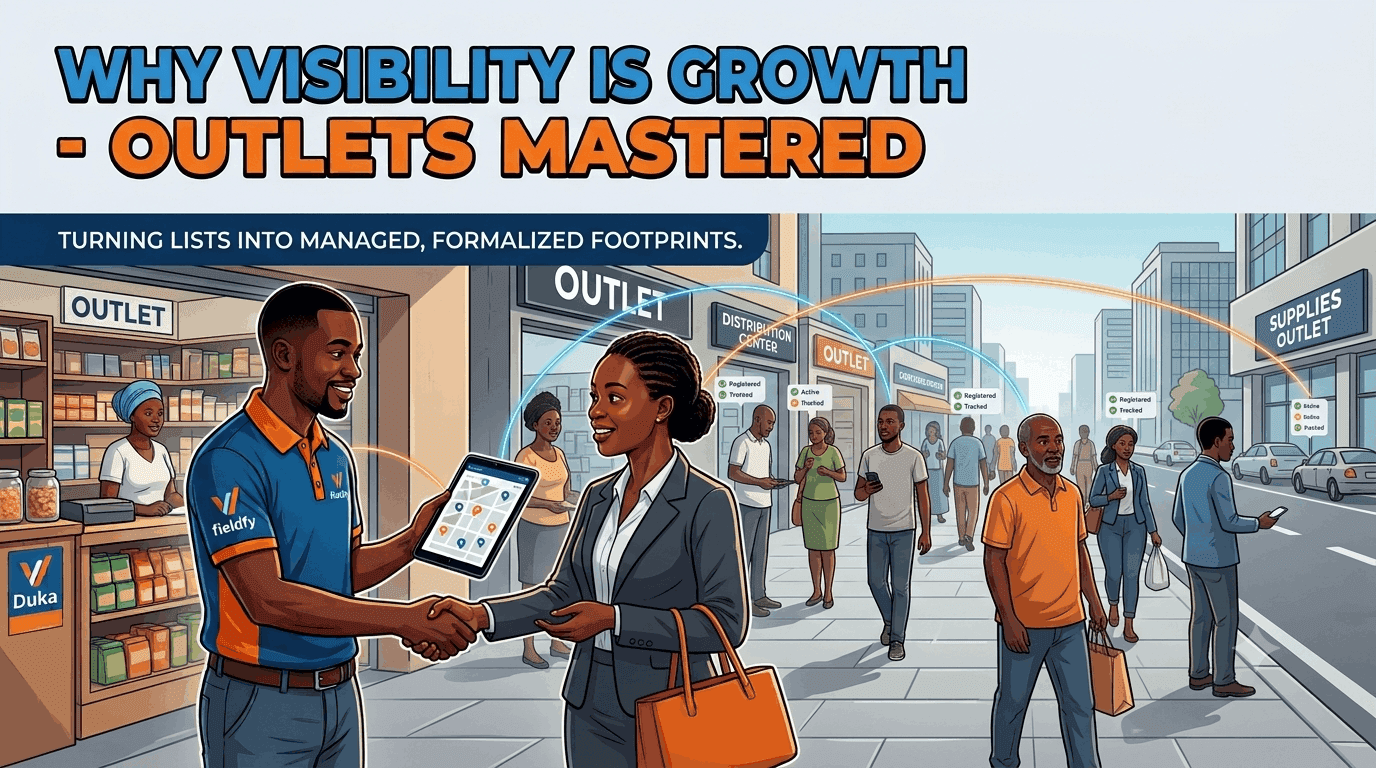
Most distributors can tell you last month's revenue instantly but ask how many outlets they're actually reaching, consistently, and most go quiet. Here's why outlet coverage, not just sales numbers, is the real measure of whether your distribution business is growing or just standing still
Chrisostom Kaweza
Jul 17, 2026 · 4 min read