
Your Sales Team Can Be Busy and Your Distribution Can Still Be Shrinking
A busy sales team does not always mean a healthy distribution network. Learn why FMCG and pharma distributors in Tanzania lose market coverage quietly and why visibility into accounts, ordering, and field activity matters more than simply adding more sales pressure.

Chrisostom Kaweza
Jul 17, 2026 · 5 min read
Updated Aug 23, 2026

Every distributor we talk to in Dar es Salaam has a sales team that looks busy. Reps leave early, come back late, phones full of calls, vans loaded and out on routes across the city all day. Nobody is sitting idle.
And yet, quietly, distribution is shrinking.
Fewer active sub-wholesalers and key accounts each month. Order sizes creeping down. Some accounts you used to supply weekly now order once a month, if at all. Meanwhile, a competitor's product is sitting on shelves downstream where yours used to be.
This is one of the more confusing problems in FMCG and pharma distribution in Tanzania, because it doesn't look like a sales problem from the inside. Activity is high. Effort is high. But activity is not the same thing as coverage, and effort is not the same thing as reach.
Busy Is Not the Same as Effective
A rep's route is built around sub-wholesalers and high-account retailers, not individual dukas vans are loaded, calls are made, and on paper the route looks completely covered. But that's exactly where things can quietly fall apart, for reasons that rarely show up in a WhatsApp check-in or an end-of-day call to the sales manager:
The rep is re-visiting the same easy, familiar sub-wholesalers and top accounts every week, while smaller or harder-to-reach accounts on the edge of the route quietly stop ordering.
A sub-wholesaler wants to order between visits, but the only channel available is "wait for the rep" or "call the office," so the order goes to whoever is easier to reach.
Stockouts on the manufacturer or main-distributor side get discovered on the rep's next visit, three days after the sub-wholesaler already switched suppliers for that SKU.
Nobody upstream not the sales manager, not the main distributor, not the manufacturer actually knows which accounts are being covered and which have silently dropped off, because the only record of "coverage" is in the rep's memory and paper notebook.
And critically, what happens below the sub-wholesaler — whether the dukas they supply are actually getting stocked — is often invisible to everyone above them.
None of this shows up as a productivity problem. It shows up, months later, as a revenue problem. By the time it's visible in the numbers, it's already been happening for a while.
Distribution in Tanzania Runs on Three Layers, and the Cracks Are in the Middle
Manufacturers and main distributors sit at the top. Sub-wholesalers sit in the middle, buying in bulk and pushing product further out. Micro-dukas the small shops on every corner sit at the bottom, closest to the end customer.
Most of the visibility gaps live in the middle and bottom of this chain. A main distributor's reps typically call directly on sub-wholesalers and high-account retailers not on individual dukas. That's efficient, but it means the main distributor's visibility into the sub-wholesaler is decent, while visibility into the thousands of micro-dukas the sub-wholesaler is supposed to be reaching is close to zero. The sub-wholesalers themselves are often running on relationships and habit, not on any system that tells them who they've lost touch with either.
So when distribution shrinks, it's rarely one dramatic event. It's death by a thousand small gaps: a sub-wholesaler or key account that used to order every Tuesday and just... stopped, three months ago, and nobody upstream noticed because the rep's route still looked full. Underneath that, dukas that the sub-wholesaler was supposed to be restocking may have already switched to a competitor's product invisible to everyone above them until sell-through data or a rare spot-check reveals it.
The Fix Isn't "Work Harder." It's "See More."
Adding more reps, more incentives, or more pressure on an already-busy sales team treats the symptom. The actual problem is a visibility and access problem:
Visibility : knowing, in near real time, which sub-wholesalers and key retailers are ordering, which have gone quiet, and which are ordering less than they used to. Not from a rep's gut feeling at the end of the month, but from actual order data.
Access : giving sub-wholesalers and high-account retailers a way to order that doesn't depend entirely on a rep physically showing up. If an account can only order when the rep visits, you've capped your own distribution at "however many accounts one person can drive to in a day" and every duka downstream of that account inherits the delay.
This is the gap Fieldfy is built to close. Fieldfy connects field activity, account coverage, and ordering into one distribution system so visibility doesn't live only in a rep's head, and ordering doesn't depend only on a rep's schedule. WhatsApp ordering is one capability inside that: sub-wholesalers and key retailers get a direct channel to their own distributor whenever they need to order not a marketplace, not a pooled catalog, just their supplier, always reachable. But the bigger shift is what sits underneath it distributors get real visibility into which accounts are active, which are drifting, and where the actual coverage gaps are, instead of finding out three months later when the numbers don't add up.
A busy sales team is a good sign. It's just not the same sign as a healthy distribution network. The two can move in opposite directions for a long time before anyone notices unless you're actually measuring the right thing.
Fieldfy, bringing your retailers closer.
Your team builds the network.
Fieldfy helps you understand it, activate it, and grow it.
See how distributors use Fieldfy to map retailers, track field visits, receive orders, and run promotions that drive sales.
Book a demoKeep reading
Related articles
-6a61e7a0a83417.76392093.png&w=3840&q=75)
Your Delivery Truck Should Deliver Not Wait for Orders
Every minute a delivery truck waits for an order adds unnecessary cost to your distribution operation. This article explores why many distributors are separating sales from delivery, how pre-selling improves efficiency, and why connecting every order into one operational workflow is becoming a competitive advantage.
Chrisostom Kaweza
Jul 23, 2026 · 6 min read
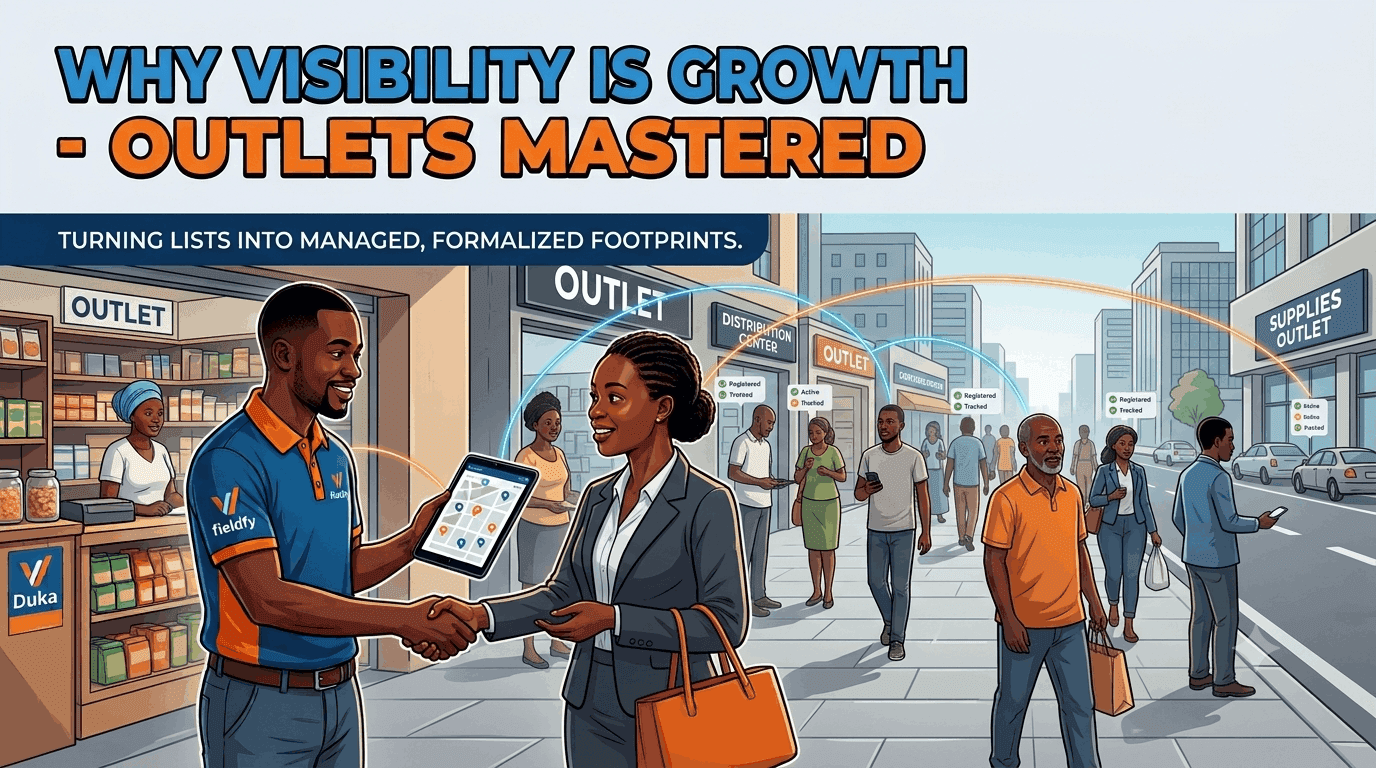
Why Knowing Your Outlet Coverage Matters More Than You Think
Most distributors can tell you last month's revenue instantly but ask how many outlets they're actually reaching, consistently, and most go quiet. Here's why outlet coverage, not just sales numbers, is the real measure of whether your distribution business is growing or just standing still
Chrisostom Kaweza
Jul 17, 2026 · 4 min read
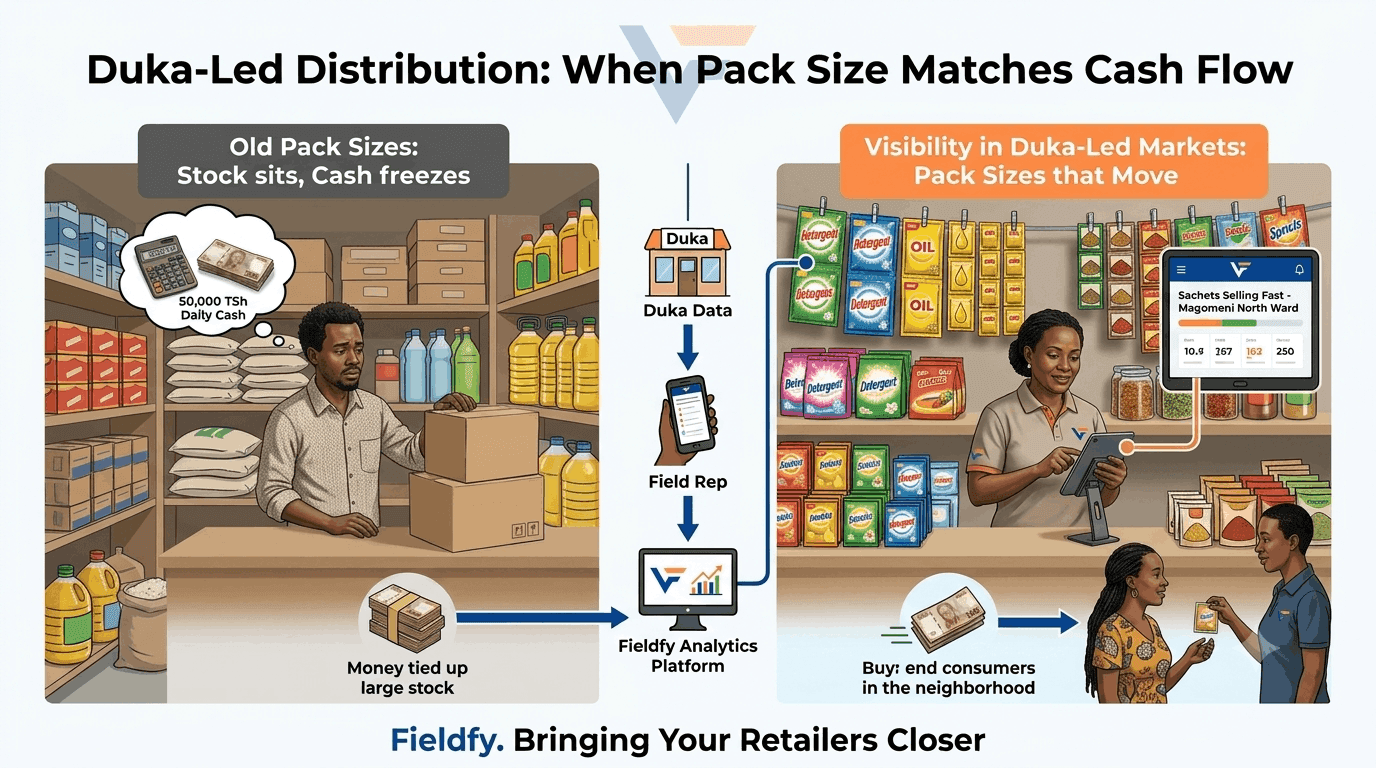
Why Your Pack Size Might Be the Reason a Duka Won't Stock You
Many manufacturers struggle to get their products into dukas not because of product quality, but because their pack sizes and pricing do not match how small retailers actually operate. Discover why pack size is a distribution strategy and how field-level visibility helps brands make smarter decisions
Chrisostom Kaweza
Jul 10, 2026 · 4 min read